
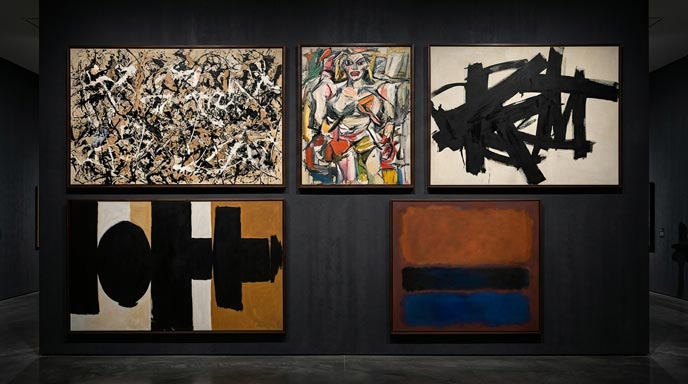
Abstract art is a term used to describe art that typically does not depict any specific subject or figure. The idea was developed in the early 20th century, and the term “abstract” has been in use since at least 1917, according to the Oxford English Dictionary.
Abstract paintings are usually stylized with flat areas of color, lines, and shapes instead of realistic images. Rather than focusing on exact visual representation, abstract art emphasizes aesthetic quality and mood, expressing emotions through universal forms rather than direct interpretation. For this reason, many people enjoy exploring abstract painting without having any specific outcome in mind.
The Rise of Abstract Expressionism
The style of Abstract Expressionism was developed by artists working in New York during the 1940s and 1950s. This movement redefined modern art and brought global attention to several influential figures, including:
- Jackson Pollock
- Willem de Kooning
- Franz Kline
- Robert Motherwell
- Mark Rothko
How to Interpret Abstract Art
Because abstract art is often simplified to the point of unrecognizability, it leaves room for widely varied interpretations.
- No fixed meaning: Some viewers believe abstract paintings carry no inherent meaning, serving purely as visual experiments.
- Emotional connection: Others argue that abstract art has a direct relationship with reality, reflecting the artist’s personal emotional experience.
In the documentary Abstract Art: An Extreme Close Up, David Hockney compares the formal properties of abstract painting with other forms of visual communication. He challenges the idea that abstract art is strictly nonfigurative, explaining that abstraction can actually evoke deeply specific emotions and meaning.
Expressing Human Emotion and Ideas
The notion that abstract art lacks meaning sparked widespread controversy during the 20th century. However, many practitioners consider it a powerful method for tapping into the universal creative imagination.
Whether inspired by personal experiences, patterns in nature, or big ideas about human life, abstract artists use form and color to communicate thoughts that traditional realistic painting simply cannot capture.
Frequently Asked Questions
Abstract art aims to express emotions, moods, and ideas through visual elements like shape, color, line, and texture, rather than trying to create an accurate depiction of a real-world object or scene.
Because it doesn’t represent recognizable objects, critics often argue whether abstract art requires skill or carries real meaning. While some view it as overly simplistic, artists and art lovers value it for its emotional depth and freedom of interpretation.
Some of the most prominent figures include Jackson Pollock, Willem de Kooning, Mark Rothko, Franz Kline, and Robert Motherwell, all of whom played major roles in the New York movement during the 1940s and 1950s.
Instead of looking for a hidden object, focus on how the colors, strokes, and shapes make you feel. Abstract art invites you to bring your own personal perspective, life experiences, and emotions to the artwork.
Not necessarily. While abstract art simplifies or distorts reality, artist David Hockney notably suggested that “the more abstract an artwork is, the more figurative it is,” as it often reflects real emotions and deep human experiences.